10. Search in Rotated Sorted Array
There is an integer array nums sorted in ascending order (with distinct values).
Prior to being passed to your function, nums is possibly rotated at an unknown pivot index k (1 <= k < nums.length) such that the resulting array is [nums[k], nums[k+1], ..., nums[n-1], nums[0], nums[1], ..., nums[k-1]] (0-indexed). For example, [0,1,2,4,5,6,7] might be rotated at pivot index 3 and become [4,5,6,7,0,1,2].
Given the array nums after the possible rotation and an integer target, return *the index of target if it is in nums, or -1 if it is not in *nums.
You must write an algorithm with O(log n) runtime complexity.
Example 1:
Input: nums = [4,5,6,7,0,1,2], target = 0
Output: 4
Example 2:
Input: nums = [4,5,6,7,0,1,2], target = 3
Output: -1
Example 3:
Input: nums = [1], target = 0
Output: -1
Constraints:
1 <= nums.length <= 5000-104 <= nums[i] <= 104- All values of
numsare unique. numsis an ascending array that is possibly rotated.-104 <= target <= 104
Solution
Overview
Define the pivot index as representing the smallest element in nums.
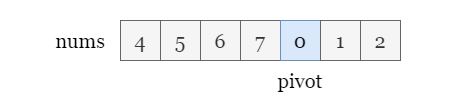
In a rotated sorted array, the pivot value signifies where the rotation occurs. It partitions the array (of length n) into two sorted portions nums[0 ~ pivot - 1] and nums[pivot ~ n - 1].
Approach 1: Find Pivot Index + Binary Search
Intuition
If you are not familiar with binary search, please refer to our explore cards Binary Search Explore Card. We will focus on the usage in this article and not the underlying principles or implementation details.
To pinpoint the pivot value, we can employ a modified binary search algorithm and find the leftmost element that is smaller than or equal to the last element in nums.
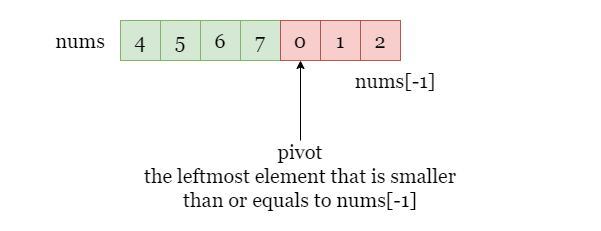
After identifying the middle element in the searching space [left ~ right], we compare nums[mid] with nums[-1].
- If
nums[mid] > nums[-1], it suggests that the pivot value lies on the right ofnums[mid]. We will then proceed with the right half of the search space, which is[mid + 1 ~ right]. - Otherwise, the pivot value is
nums[mid]or it's situated to the left ofnums[mid], we continue with the left half of the searching space, which is[left ~ mid - 1].
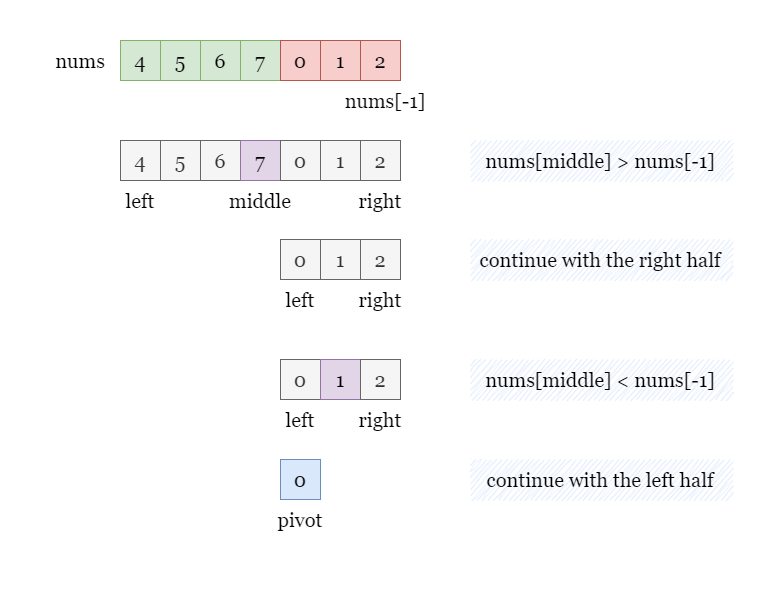
By determining the pivot value, we set the boundaries for our subsequent binary searches. Once we have the pivot value, we can execute two binary searches on each half of the array to locate the target element.
Note: the typical way to calculate
midis(left + right) / 2. However, a safer way isleft + (right - left) / 2. The two equations are equivalent, but the second one is safer because it guarantees no number larger thanrightis ever stored. In the first equation, ifleft + rightis huge, then it could end up overflowing.
Algorithm
-
Perform a binary search to locate the pivot element by initializing the boundaries of the searching space as
left = 0andright = n - 1. Whileleft < right:- Let
mid = left + (right - left) // 2. - If
nums[mid] > nums[n - 1], this suggests thatpivotis located to the right ofmid, hence we setleft = mid + 1. Otherwise,pivotcould be either atmidor to the left ofmid, in which case we should setright = mid - 1.
- Let
-
Upon completion of the binary search, we have the pivot index denoted as
pivot = left. -
numsconsists of two sorted subarrays,nums[0 ~ left - 1]andnums[left ~ n - 1]. -
Perform a binary search over
nums[0 ~ left - 1]fortarget. Iftargetis within this subarray, return its index. -
Otherwise, perform a binary search over
nums[left ~ n - 1]fortarget. Iftargetis within this subarray, return its index. Otherwise, return-1.
Implementation
- JavaScript
- C++
var search = function (nums, target) {
    let n = nums.length;
    let left = 0,
        right = n - 1;
    // Find the index of the pivot element (the smallest element)
    while (left <= right) {
        let mid = Math.floor((left + right) / 2);
        if (nums[mid] > nums[n - 1]) {
            left = mid + 1;
        } else {
            right = mid - 1;
        }
    }
    function binarySearch(left_boundary, right_boundary, target) {
        let left = left_boundary,
            right = right_boundary;
        while (left <= right) {
            let mid = Math.floor((left + right) / 2);
            if (nums[mid] == target) {
                return mid;
            } else if (nums[mid] > target) {
                right = mid - 1;
            } else {
                left = mid + 1;
            }
        }
        return -1;
    }
    // Binary search over elements on the pivot element's left
    let answer = binarySearch(0, left - 1, target);
    if (answer != -1) {
        return answer;
    }
    // Binary search over elements on the pivot element's right
    return binarySearch(left, n - 1, target);
};
class Solution {
public:
    int search(vector<int>& nums, int target) {
        int n = nums.size();
        int left = 0, right = n - 1;
        // Find the index of the pivot element (the smallest element)
        while (left <= right) {
            int mid = (left + right) / 2;
            if (nums[mid] > nums[n - 1]) {
                left = mid + 1;
            } else {
                right = mid - 1;
            }
        }
        // Binary search over elements on the pivot element's left
        int answer = binarySearch(nums, 0, left - 1, target);
        if (answer != -1) {
            return answer;
        }
        // Binary search over elements on the pivot element's right
        return binarySearch(nums, left, n - 1, target);
    }
    // Binary search over an inclusive range [left_boundary ~ right_boundary]
    int binarySearch(vector<int>& nums, int leftBoundary, int rightBoundary,
                     int target) {
        int left = leftBoundary, right = rightBoundary;
        while (left <= right) {
            int mid = (left + right) / 2;
            if (nums[mid] == target) {
                return mid;
            } else if (nums[mid] > target) {
                right = mid - 1;
            } else {
                left = mid + 1;
            }
        }
        return -1;
    }
};
Complexity Analysis
Let n be the length of nums.
-
Time complexity: O(logn)
- The algorithm requires one binary search to locate
pivot, and at most 2 binary searches to findtarget. Each binary search takes O(logn) time.
- The algorithm requires one binary search to locate
-
Space complexity: O(1)
- We only need to update several parameters
left,rightandmid, which takes O(1) space.
- We only need to update several parameters
Approach 2: Find Pivot Index + Binary Search with Shift
Intuition
The array we're working with has been rotated by a certain number of steps, which means we can't apply a regular binary search to the modified array. However, if we can revert this array to its original sorted form, then a conventional binary search becomes a viable approach.
Our key task is to locate pivot, the index of the smallest value in nums. Notably, nums[pivot] would have been at index 0 in the unrotated, original array. Hence, if we were to rotate it to the right by n - pivot steps (taking the modulus of n into account), it would return to its original position, index 0.
Applying the same transformation to every element enables us to revert the rotated array back to its original, sorted form.
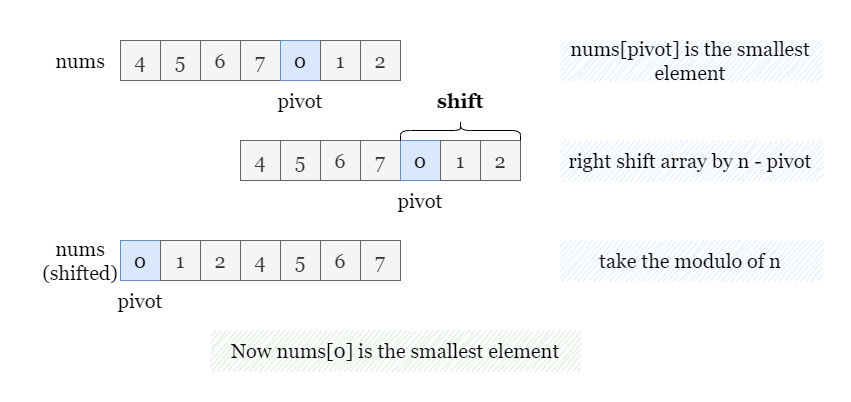
At this point, we can perform a conventional binary search to locate the target. Let's assume that nums[i] = target. Remembering that we had to shift every element to the right by n - pivot steps to reach the sorted version of nums, we now need to shift the index in the sorted nums to the left by n - pivot steps to find its corresponding index, i, in the original nums. This gives us i - (n - pivot) (taking the modulus of n into account).
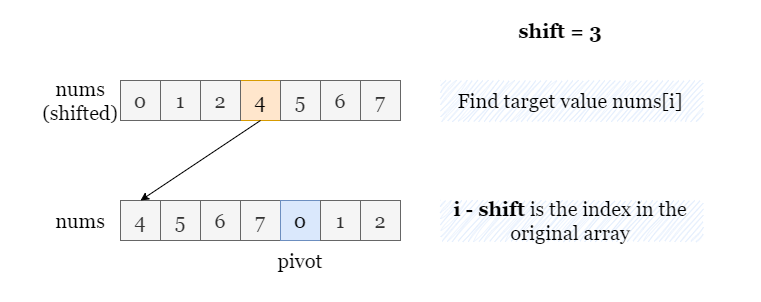
Crucially, there's no need to actually create the sorted version of nums from the original nums. We can simply represent the sorted nums by shifting the indices.
Algorithm
-
Perform a binary search to locate the pivot element by initializing the boundaries of the searching space as
left = 0andright = n - 1. Whileleft < right:- Let
mid = left + (right - left) // 2. - If
nums[mid] > nums[n - 1], this suggests thatpivotis located to the right ofmid, hence we setleft = mid + 1. Otherwise,pivotcould be either atmidor to the left ofmid, in which case we should setright = mid - 1.
- Let
-
Upon completion of the binary search, we have the pivot index denoted as
pivot = left. -
Set the boundaries of the search space as
(pivot + shift) % nand(pivot - 1 + shift) % n. -
While
left < right, we get the middle indexmid = (left + right) // 2, and comparenums[(mid - shift + n) % n]withtarget.- If
nums[(mid - shift + n) % n]is equal totarget, returnmid - shift + n - If
nums[(mid - shift + n) % n] > target, continue with the left half by settingrightasmid - 1. - If
nums[(mid - shift + n) % n] < target, continue with the right half by settingleftasmid + 1.
- If
-
Return
-1once the binary search is complete.
Implementation
Solution:
- JavaScript
- C++
var search = function (nums, target) {
    var n = nums.length;
    var left = 0,
        right = n - 1;
    // Find the index of the pivot element (the smallest element)
    while (left <= right) {
        var mid = Math.floor((left + right) / 2);
        if (nums[mid] > nums[n - 1]) {
            left = mid + 1;
        } else {
            right = mid - 1;
        }
    }
    return shiftedBinarySearch(nums, left, target);
    // Shift elements in a circular manner, with the pivot element at index 0.
    // Then perform a regular binary search
    function shiftedBinarySearch(nums, pivot, target) {
        var n = nums.length;
        var shift = n - pivot;
        var left = (pivot + shift) % n;
        var right = (pivot - 1 + shift) % n;
        while (left <= right) {
            var mid = Math.floor((left + right) / 2);
            if (nums[(mid - shift + n) % n] == target) {
                return (mid - shift + n) % n;
            } else if (nums[(mid - shift + n) % n] > target) {
                right = mid - 1;
            } else {
                left = mid + 1;
            }
        }
        return -1;
    }
};
class Solution {
public:
    int search(vector<int>& nums, int target) {
        int n = nums.size();
        int left = 0, right = n - 1;
        // Find the index of the pivot element (the smallest element)
        while (left <= right) {
            int mid = (left + right) / 2;
            if (nums[mid] > nums[n - 1]) {
                left = mid + 1;
            } else {
                right = mid - 1;
            }
        }
        return shiftedBinarySearch(nums, left, target);
    }
    // Shift elements in a circular manner, with the pivot element at index 0.
    // Then perform a regular binary search
    int shiftedBinarySearch(vector<int>& nums, int pivot, int target) {
        int n = nums.size();
        int shift = n - pivot;
        int left = (pivot + shift) % n;
        int right = (pivot - 1 + shift) % n;
        while (left <= right) {
            int mid = (left + right) / 2;
            if (nums[(mid - shift + n) % n] == target) {
                return (mid - shift + n) % n;
            } else if (nums[(mid - shift + n) % n] > target) {
                right = mid - 1;
            } else {
                left = mid + 1;
            }
        }
        return -1;
    }
};
Complexity Analysis
Let n be the length of nums.
-
Time complexity: O(logn)
- The algorithm requires one binary search to locate
pivotand one binary search over the shifted indices to findtarget. Each binary search takes O(logn) time.
- The algorithm requires one binary search to locate
-
Space complexity: O(1)
- We only need to update several parameters
left,rightmidandshift, which takes O(1) space.
- We only need to update several parameters
Approach 3: One Binary Search
Intuition
The two preceding approaches both comprise two steps:
- Perform a binary search to identify the pivot index.
- Conduct another binary search to locate the target value.
However, we can perform these two steps within a single binary search.
Let's take a step back and consider a regular binary search. Why are we able to confidently discard half of the array after comparing target with the middle value nums[mid]? The reason is that both halves of the array are sorted. Hence, if target is less than the middle value, it's assured to be smaller than every value in the right half. If target is larger than the middle value, it's guaranteed to be larger than every value in the left half. Therefore, we can safely discard one half of nums in either case.
However, a rotated sorted array may not possess this characteristic -- we can't determine whether target is definitively not in the array just by comparing boundary values.
If we cut a subarray nums[left ~ right] by the index mid. We split this subarray into 3 parts:
- subarray
nums[left ~ mid - 1] - element
nums[mid]. - subarray
nums[mid + 1, right].
It is important to note that there is at most one rotated sorted array in the two subarrays, which means that there is at least one sorted array for comparison.
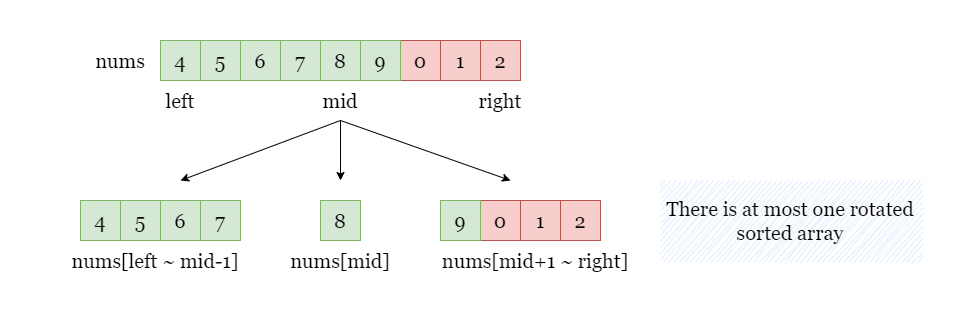
Therefore, we can compare target with the sorted half to decide which subarray to retain for the next round.
It is straightforward to determine if a sorted array
A[l ~ r]could possibly containtarget, we can simply comparetargetwith two boundary valuesA[l]andA[r].
- If
A[l] <= target <= A[r], thenA[l ~ r]might containtarget, which needs to be verified by binary search, we will continue with this subarray.
- Otherwise,
targetis guaranteed to not be inA[l ~ r], and there is no need to search over this array, we will continue with the other subarray.
To sum up, there are 3 possible cases after comparing target with nums[mid]:
Case 1. If nums[mid] = target, which denotes that we have found target, return mid as its index.
Case 2. If nums[mid] >= nums[left]. It implies that the left subarray nums[left ~ mid] is sorted. We can determine whether to proceed with this subarray by comparing target with the boundary elements:
- If
nums[left] <= targetandtarget < nums[mid], it suggests that the sorted left half might includetargetwhile the other half does not containtarget. Consequently, we focus on the left half for further steps. - Otherwise, the left half is guaranteed not to contain
target, and we will move on to the right half.
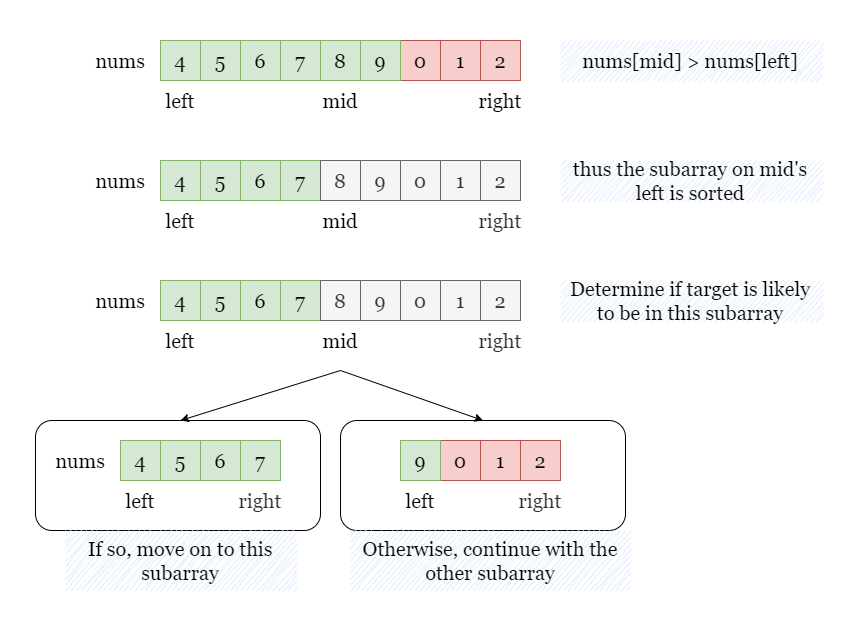
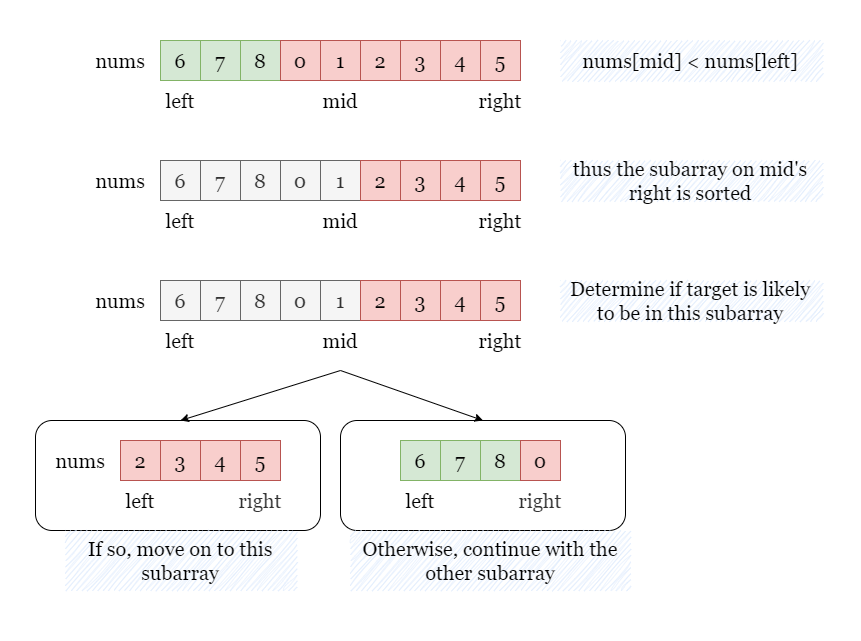
Case 3. If nums[mid] < nums[left], it implies that the left subarray is rotated and the right subarray nums[mid ~ right] is sorted. Therefore, we can determine whether to proceed with the right subarray by comparing the target with its boundary elements:
- If
nums[mid] < targetandtarget < nums[right], it implies that the sorted right half might containtarget. As a result, we will move on with the right half. - Otherwise, the right half is guaranteed not to contain
target, and we will move on to the left half.
Algorithm
-
Initialize pointers:
- Set
leftto 0. - Set
rightton - 1wherenis the length of the arraynums.
- Set
-
Perform binary search:
- While
leftis less than or equal toright:-
Calculate the middle index
midasleft + (right - left) / 2. -
Case 1: Check if the middle element
nums[mid]is equal totarget.- If true, return
midas the index oftarget.
- If true, return
-
Case 2: Check if the subarray from
lefttomidis sorted (nums[mid] >= nums[left]).- If
targetis within the range[nums[left], nums[mid]):- Adjust the search range by setting
righttomid - 1.
- Adjust the search range by setting
- Otherwise:
- Adjust the search range by setting
lefttomid + 1.
- Adjust the search range by setting
- If
-
Case 3: If the subarray from
midtorightis sorted (nums[mid] > nums[right]):- If
targetis within the range(nums[mid], nums[right]]:- Adjust the search range by setting
lefttomid + 1.
- Adjust the search range by setting
- Otherwise:
- Adjust the search range by setting
righttomid - 1.
- Adjust the search range by setting
- If
-
- While
-
If the target is not found, return
-1.
Implementation
- JavaScript
- C++
var search = function (nums, target) {
    let n = nums.length;
    let left = 0,
        right = n - 1;
    while (left <= right) {
        let mid = left + (((right - left) / 2) | 0);
        // Case 1: find target
        if (nums[mid] == target) return mid;
        // Case 2: Subarray on mid's left is sorted
        else if (nums[mid] >= nums[left]) {
            if (target >= nums[left] && target < nums[mid]) right = mid - 1;
            else left = mid + 1;
        }
        // Case 3: Subarray on mid's right is sorted
        else {
            if (target <= nums[right] && target > nums[mid]) left = mid + 1;
            else right = mid - 1;
        }
    }
    return -1;
};
class Solution {
public:
    int search(vector<int>& nums, int target) {
        int n = nums.size();
        int left = 0, right = n - 1;
        while (left <= right) {
            int mid = left + (right - left) / 2;
            // Case 1: Find target
            if (nums[mid] == target) {
                return mid;
            }
            // Case 2: Subarray on mid's left is sorted
            else if (nums[mid] >= nums[left]) {
                if (target >= nums[left] && target < nums[mid]) {
                    right = mid - 1;
                } else {
                    left = mid + 1;
                }
            }
            // Case 3: Subarray on mid's right is sorted
            else {
                if (target <= nums[right] && target > nums[mid]) {
                    left = mid + 1;
                } else {
                    right = mid - 1;
                }
            }
        }
        return -1;
    }
};
Complexity Analysis
Let n be the length of nums.
-
Time complexity: O(logn)
- This algorithm only requires one binary search over
nums.
- This algorithm only requires one binary search over
-
Space complexity: O(1)
- We only need to update several parameters
left,rightandmid, which takes O(1) space.
- We only need to update several parameters